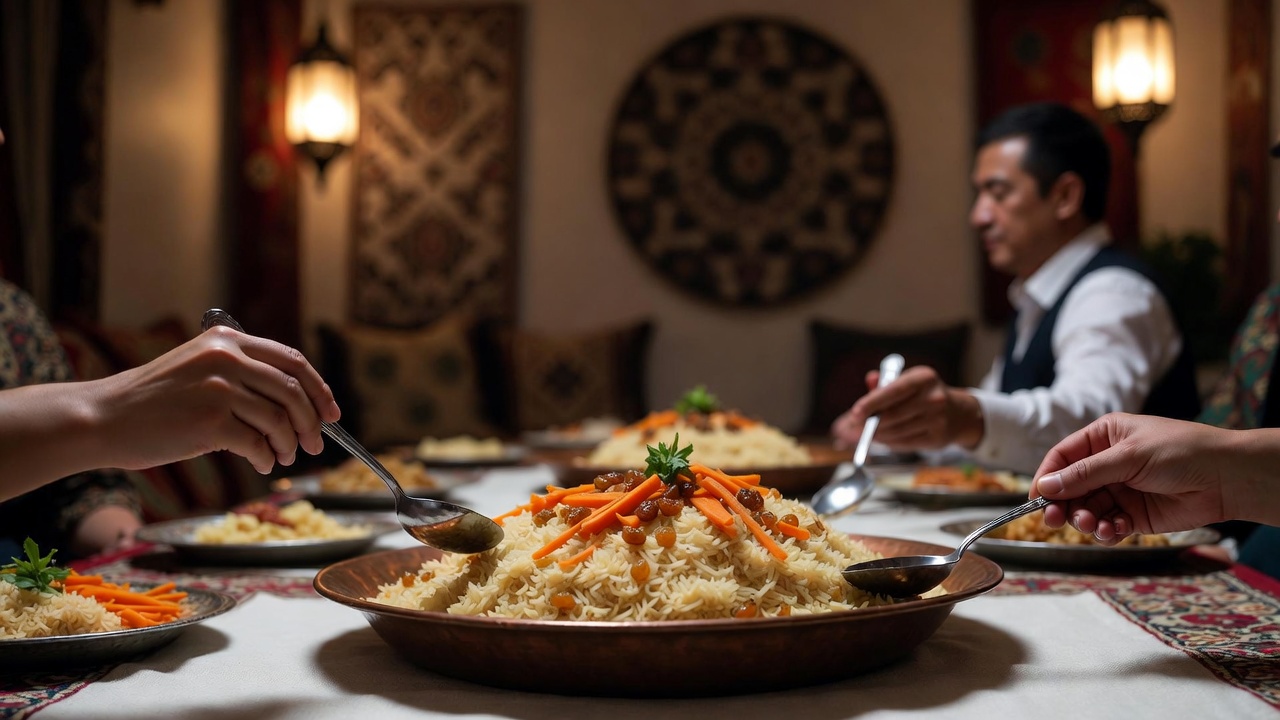
You've prepared for negotiations: compiled a presentation, printed the contract, booked a conference room. Then your Uzbek partner says: "Let's grab some plov first — I know a great place." Many foreign businesspeople get confused at this moment. Why plov when we can get straight to business? In this article, we'll explore why in Uzbek business culture, dining together is not a distraction from negotiations, but rather their most crucial component. And how you can use this knowledge to build relationships faster and stronger.
The Conference Room is a Western Idea
In Western business culture, everything is crystal clear: meeting on the calendar, agenda, timer, decision. Time is money, emotions stay outside, documents on the table.
Uzbek business culture operates on a different logic. Here, the main asset is trust. Not a contract, not legal protection, not KPIs. Trust between people. And this trust doesn't emerge in a conference room in an hour. It builds slowly, through personal contact, through shared time, through dining together.
A conference room is for people who already trust each other. Plov is where that trust is created.
What Plov Means in Uzbek Culture
Plov in Uzbekistan is not just a dish. It's a ritual with thousands of years of history.
It's prepared at weddings and funerals, at celebrations and before long journeys. It's cooked by men — in a large cauldron, over an open fire, for large groups. Preparing plov takes hours. This in itself sends a message: I'm spending time for you.
In Uzbek tradition, inviting someone for plov means recognizing them as one of your own. Not as a guest, not as a client, not as a contract partner. As one of your own. Someone you trust.
This is why serious negotiations in Uzbekistan often begin not with a presentation, but with a dastarkhan — a laid table. First you eat. Then you talk business.
How This Works in Practice
Stage 1 — Getting to Know Each Other Over Food
Your first meeting with an Uzbek partner is rarely business-like in the Western sense. Most likely, you'll be invited to eat — at a restaurant, a teahouse, or someone's home. This isn't a social conversation before business. This is the business.
Over food, your partner studies you as a person: how you carry yourself, how you treat food and hospitality, whether you can listen, if you have a sense of humor. If you're in a hurry, checking your phone, and only talking about business — that's a bad signal.
Stage 2 — Shared Time as Investment
In Uzbek culture, the time you spend together is an investment in the relationship. The more time you spend at the same table, the stronger the bond.
This is why Uzbek business lunches last so long. Not because there's no work to do. But because time at the table is the work itself.
Stage 3 — Business Comes After the Meal
Once trust is established — business conversations flow easily and quickly. An Uzbek partner who has welcomed you is a reliable partner. He won't let you down not because he fears lawyers, but because it would be a disgrace before the people he has shared a table with.
This is the true legal protection in the Uzbek sense — reputation and honor matter more than any contract.
Plov as a Measure of Serious Intent
In Uzbek business circles, there's an unspoken scale of meeting seriousness:
Coffee at a café — to meet, to chat about nothing. No commitments.
Lunch at a restaurant — there's interest, willing to consider cooperation. First step toward a relationship.
Plov at a nice place — serious talk. The partner sees you as a potential one of their own.
Plov at home or a family event — the highest level of trust. You're no longer a partner — you're almost family.
If you're invited for plov — that's a good sign. If to someone's home — that's excellent.
Local Customs: What You Need to Know at the Table
The eldest eats first. At an Uzbek table, hierarchy is observed. The most respected person at the table starts the meal. Don't rush — observe.
Bread is sacred. Naan bread cannot be placed upside down or thrown away. Bread is broken by hand and passed to neighbors — this is a gesture of respect.
Tea is poured in small amounts. If the host pours you tea only halfway up the cup — this is a sign of respect. A full cup means "it's time to go." Don't be offended if they don't refill — you're being honored.
Never refuse food. Refusing food in Uzbek culture is seen as disrespect to the host. Even if you're not hungry — try at least a little.
Keep your phone away. A phone in your hands at an Uzbek dastarkhan signals that you're not interested. Put it away and be present.
Who pays decides. Whoever invited — whoever pays. Don't argue. You can suggest splitting the bill once — if they insist on paying, accept with gratitude.
What This Means for Your Business in Uzbekistan
If you work with Uzbek partners or plan to enter the Uzbek market — rethink the logic of your first meetings.
Don't rush to the contract. A partner who doesn't know you won't sign anything serious. First relationships — then documents.
Invest in shared time. Lunch, dinner, a walk around the city — this isn't wasted time. This is building a foundation.
Accept invitations. If you're invited for plov — go. Even if you're busy. Turning down an invitation is taken painfully.
Extend invitations yourself. Organize a meal for your partner. Choose a nice place, pay the bill. This is an investment that pays off.
Don't mix formats. If you're having plov — have plov. Don't pull out your laptop or spread out contracts. Time for documents will come — but not now.
What Western Business Can Learn from Uzbek Dining Culture
Western business culture is increasingly recognizing what Uzbekistan has always known: relationships matter more than transactions.
Research shows that long-term business partnerships are built not on favorable contract terms, but on personal trust between people. Companies with strong cultures of internal trust show results many times better.
Corporate lunches, team building, informal meetings — these are attempts by Western business to recreate what in Uzbekistan is a natural part of culture.
The difference is that here it's not a corporate ritual. It's life.
Frequently Asked Questions
Do I have to go for plov if invited? Yes, you should. Refusing without a good reason is seen as a signal of disinterest. If you really can't — explain why and suggest another date. It's important not to leave an invitation unanswered.
Can I organize plov for an Uzbek partner myself? Great idea. If you're foreign and organize plov — it will be highly appreciated. It shows that you respect the culture and are willing to invest in relationships. Choose a good restaurant with authentic plov and cover the bill.
When can you talk business over plov? Don't rush. Wait for your partner to bring up business — this usually happens toward the end of the meal or after tea. If you start talking business at the beginning of lunch — you signal that you came for a contract, not a relationship.
What if I don't eat certain foods? Mention it in advance and gently. Uzbek hospitality is very flexible — the host will find something to offer. Just don't refuse to dine altogether.
Is plov served with alcohol or without? Traditional plov is without alcohol. Many Uzbek business partners don't drink for religious reasons. Don't offer alcohol first — wait for your partner to indicate their position on this matter.