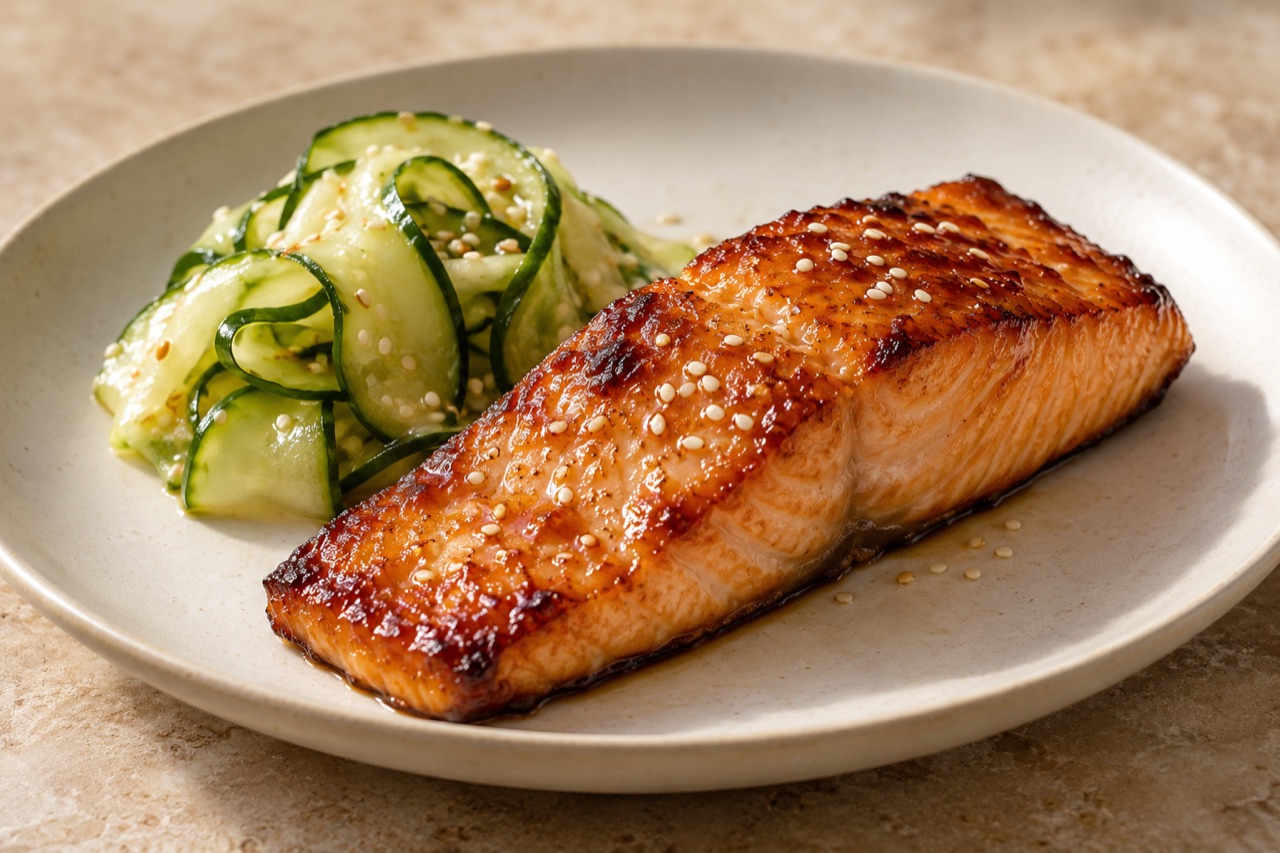
First comes a delicate caramelized crust. Then tender salmon and the cool crunch of cucumber. This dinner has all the elegance of a fine restaurant, yet it comes together on an ordinary home kitchen.
The secret lies in white miso paste: it delivers a deep, savory depth. Honey softens this and helps the glaze caramelize beautifully, while rice vinegar adds a subtle tang.
Serves 2 · approximately 35–40 minutes · no lengthy marinating
Prep time — 15 minutes. Oven time — roughly 12–18 minutes.
You'll need an oven, a small baking sheet, a vegetable peeler, and ideally a kitchen thermometer.
What to Buy
For the Salmon and Glaze
| Ingredient | Serves 2 |
|---|---|
| Salmon fillets with skin | 2 pieces, 170–200 g each |
| White miso paste — shiro miso | 1 tbsp, about 18 g |
| Honey | 2 tsp |
| Soy sauce | 1 tsp |
| Rice vinegar (unsweetened) | 2 tsp |
| Fresh ginger, finely grated | ½ tsp |
| Neutral vegetable oil | 1 tsp |
For the Cucumber Salad
- Cucumbers — 2 small, about 250 g total.
- Rice vinegar (unsweetened) — 2 tsp.
- Toasted sesame oil — ½ tsp.
- Sugar — ½ tsp.
- Sesame seeds — 2 tsp: half for the salad, half for garnish.
- Salt — a small pinch, to taste.
Miso and soy sauce are already salty: you typically won't need to salt the fish separately. For this recipe, use white miso specifically—it has a gentler flavor profile. Thaw frozen fish in the refrigerator beforehand.
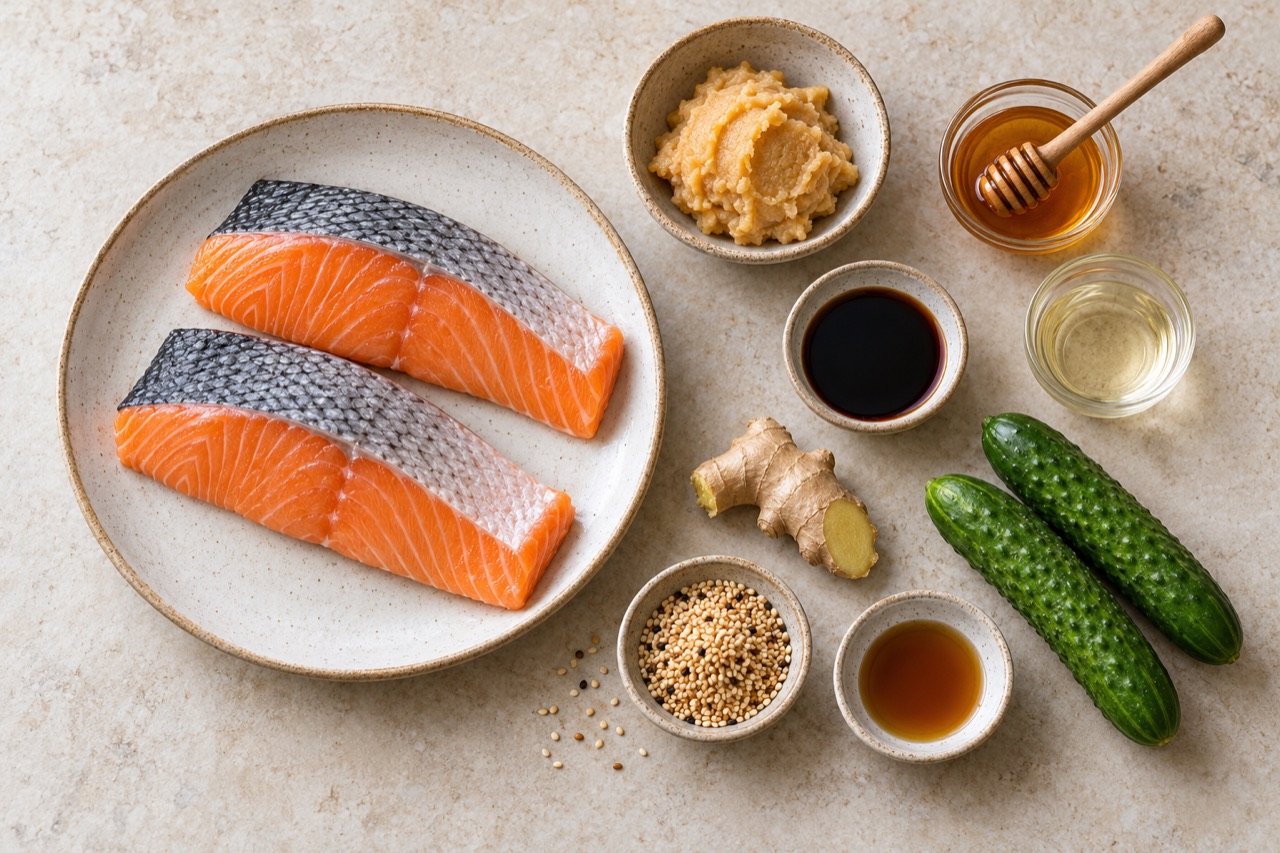
Recipe ingredients. Illustration created with AI; exact measurements listed above.
Step-by-Step Instructions
01 / Prepare the Oven and Fish
Preheat your oven to 200 °C with top and bottom heat or 180 °C with convection. Place the rack at the middle level.
Line a small baking sheet with foil and brush it with half the oil. Check the fillets for any remaining bones, pat dry with paper towels, and place them skin-side down, leaving a little space between pieces.
A good rule of thumb: two pieces of similar thickness, about 2.5–3 cm, will cook more evenly than a thin tail end and a thick center.
02 / Mix the Glaze
In a small bowl, combine miso, honey, soy sauce, rice vinegar, ginger, and the remaining oil. Stir with a spoon until smooth and uniform.
You'll have a thick but easily spreadable sauce. If the paste seems very dense, add 1 tsp of water.
Divide the glaze into two portions right away. Use one portion now, and keep the second in a separate clean bowl for the final layer. Don't dip your brush back into the clean portion after it's touched raw fish.
03 / Bake the Salmon
Spread the first half of the glaze in a thin, even layer over the top of each fillet. Don't coat the fish in a thick layer of sauce—honey and miso brown quickly.
Bake for 8–10 minutes, then remove the sheet and apply the remaining glaze with a clean spoon. Return to the oven for another 4–8 minutes.
Baking time varies depending on fillet thickness, starting temperature, and your specific oven. The key indicator of doneness is 63 °C in the thickest part of the fish. Insert the thermometer from the side so the tip reaches the center of the flesh, not the baking sheet.
If the glaze browns too quickly: cover the fish loosely with foil, leaving a small gap above the surface, and continue baking until done. You want an amber color, not blackened bitterness.
04 / Create the Cucumber Ribbons
While the fish bakes, rinse and dry the cucumbers. Using a vegetable peeler, draw long, thin ribbons by rotating the cucumber. You can set aside the watery center with large seeds for another salad.
In a separate bowl, mix the vinegar, sesame oil, sugar, and a small pinch of salt. Don't dress the cucumbers yet—this keeps them crisp and prevents them from releasing excess liquid too early.
05 / Plate and Serve
Let the cooked salmon rest for 2 minutes. Meanwhile, toss the cucumber ribbons with the dressing and half the sesame seeds.
Using a wide spatula, transfer one piece of salmon to each plate. Arrange a small nest of salad alongside, squeezing out any excess dressing first. Sprinkle the salmon with the remaining sesame seeds and serve immediately.
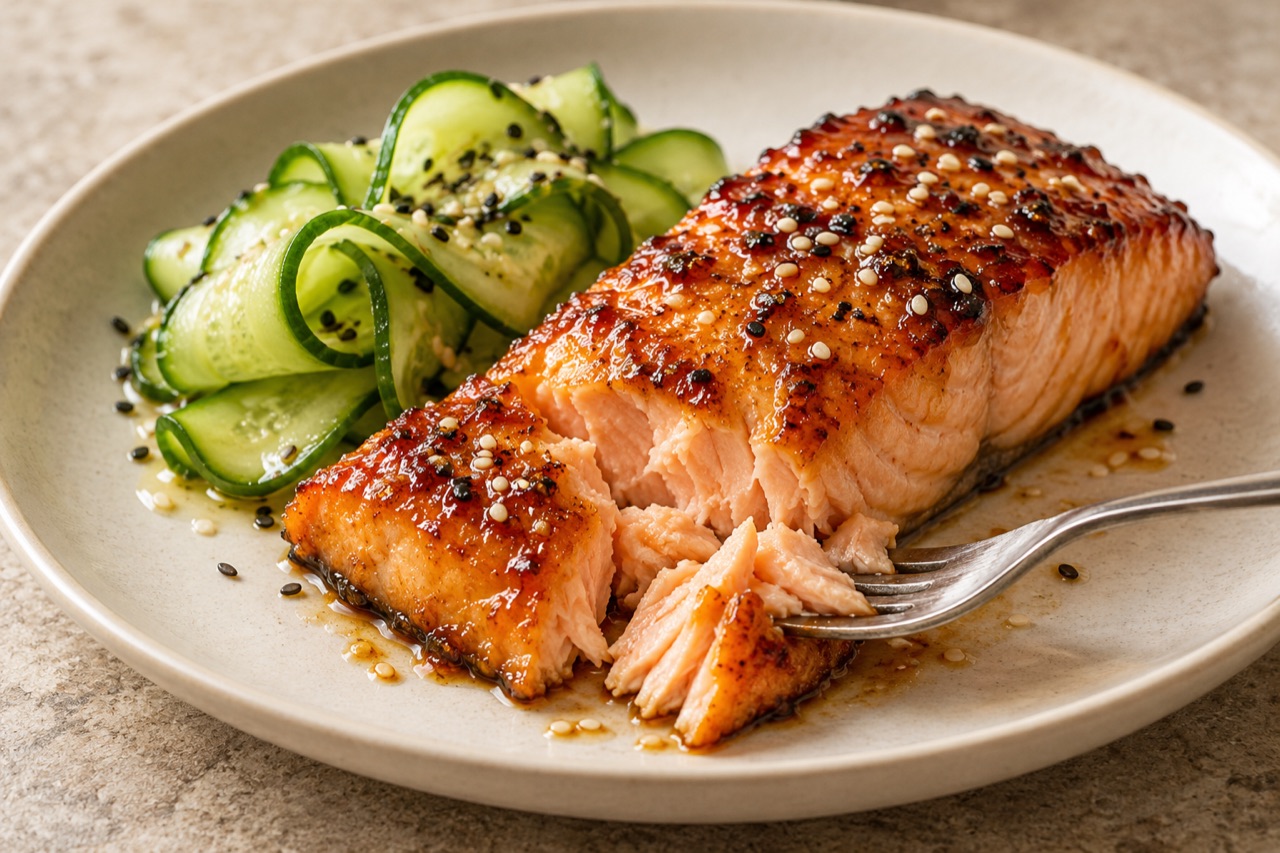
One plating option with cucumber ribbons. Illustration created with AI.
How to Plate Beautifully
Choose a calm, understated plate. On a light matte surface, the amber glaze and green cucumbers appear especially striking.
Leave breathing room. Position the salmon slightly off-center, with the salad arranged compactly beside it. Don't scatter garnishes across the whole plate.
Keep the glaze on the fish. A puddle of sauce underneath will quickly mix with cucumber juice. A thin, glossy coating looks far more elegant.
For a heartier dinner, serve jasmine rice on the side. It complements the dish without competing with the glaze.
Three Details That Make the Difference
| If… | Do This |
|---|---|
| The glaze tastes too salty | Before it touches the fish, add a bit of water and honey; apply a thinner layer. Saltiness varies by miso brand. |
| The top darkens quickly while the center isn't done | Cover with foil and check internal temperature. Don't increase heat just for a crust. |
| The salad becomes watery | Dress it just before serving and transfer it without excess liquid. |
Ingredient Substitutions
- Salmon → Trout. Use individual fillets of similar thickness; check doneness with a thermometer.
- Rice vinegar → Apple cider vinegar. Start with half the amount and add more if needed: the flavor will be slightly different.
- Honey → Maple syrup. Use the same volume.
- Vegetable peeler → Regular knife. Slice the cucumbers into thin rounds.
Miso has no true substitute in this recipe. Using only soy sauce will create a different glaze—delicious, but without the characteristic depth of fermented paste.
A home version inspired by contemporary restaurant cuisine. This recipe is not attributed to a specific chef or Michelin-starred restaurant. Illustrations created with AI and show one plating option.